
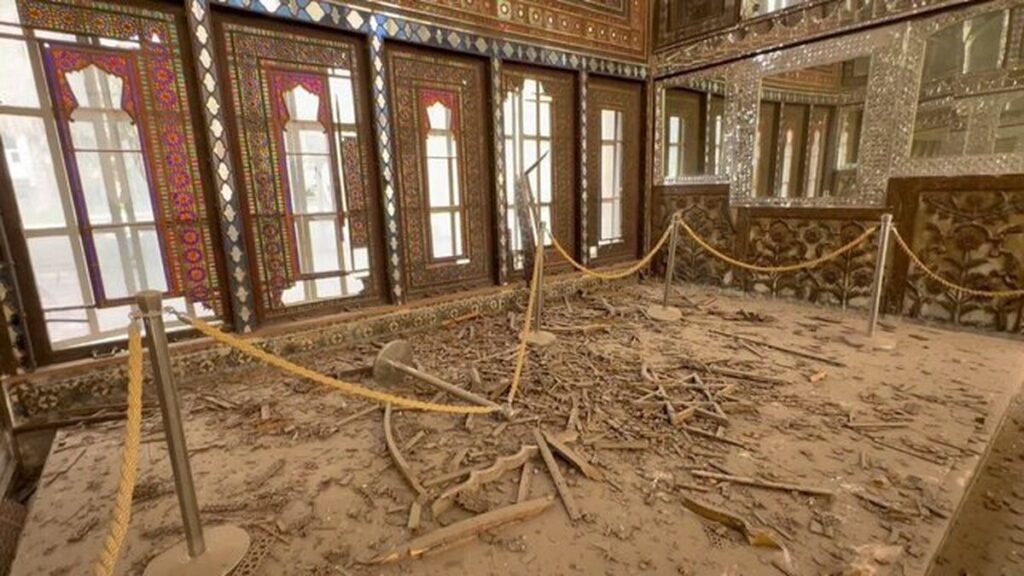
Tehran — The echoes of modern warfare have reached deep into the architectural memory of Iran. The historic Golestan Palace, a jewel of Persian heritage and the only UNESCO World Heritage site in the Iranian capital, has sustained damage following nearby airstrikes amid the escalating military war started by United States and Israel.
Preliminary assessments from Iranian officials and international observers indicate that the palace complex — a centuries-old royal ensemble known for its mirror-lined halls, intricate tilework, and ceremonial architecture — suffered structural and decorative damage after explosions struck an area near Arag Square in central Tehran. The resulting shockwaves and debris reached the palace grounds, breaking windows, damaging historic decorative elements, and sending fragments of centuries-old ornamentation to the floor.
The incident marks a troubling moment in the conflict: the war has begun to touch not only military infrastructure but also the physical legacy of one of the world’s oldest civilizations.
A Palace at the Heart of Persian History
Dating back to the Safavid era and expanded during the Qajar dynasty, Golestan Palace stands as one of the most important surviving symbols of Persian royal architecture. Its halls witnessed the coronations of Iran’s last monarchs and the diplomatic ceremonies that shaped modern Iranian history.
The palace complex contains several architectural masterpieces, including the famous Marble Throne terrace and the celebrated Hall of Mirrors — spaces that combine Persian craftsmanship with European artistic influences. UNESCO inscribed the complex on the World Heritage List in 2013, recognizing it as a unique synthesis of traditional Persian architecture and 19th-century modernization.
Today the palace functions as both a museum and a living monument to Iran’s artistic heritage, attracting scholars, tourists, and historians from across the world.
That legacy has now been shaken.
Shockwaves Shatter Mirrors and Windows
According to early reports from cultural heritage authorities and international media, the blast waves from nearby strikes shattered historic windows and damaged delicate architectural details throughout parts of the palace complex.
Officials said fragments of ceiling ornamentation dating to the mid-18th century fell inside ceremonial halls, while parts of the palace’s famed mirror work — one of the most fragile and distinctive features of Qajar architecture — were damaged.
In several rooms, glass panels and wooden doors were reportedly blown open by the pressure of the explosions. The palace grounds also showed signs of structural stress caused by the shockwaves, prompting urgent calls for technical inspection and stabilization.
UNESCO confirmed that the damage occurred after an airstrike within the buffer zone surrounding the heritage site, an area designated to protect the monument from exactly such risks.
Cultural heritage experts warn that even limited blast damage can have long-term consequences for fragile historical structures, particularly those containing centuries-old materials.
“An Attack on Cultural Memory”
Iranian cultural officials described the damage as more than an architectural loss.
“This is not only damage to a building,” one official said during an early inspection visit. “It is damage to Iran’s cultural identity.”
Iran has announced that it will submit a formal report to UNESCO documenting the extent of the destruction and requesting international monitoring and assistance for preservation efforts.
Experts say the next steps will involve detailed structural surveys, conservation assessments, and emergency protective measures to prevent further deterioration.
UNESCO Raises Alarm Over Cultural Heritage
The United Nations’ cultural agency has expressed concern over the incident, reminding all parties involved in the conflict that historical sites are protected under international law.
Under the 1954 Hague Convention for the Protection of Cultural Property in the Event of Armed Conflict, cultural heritage sites must be safeguarded during military operations. UNESCO has also reiterated that it had previously shared the coordinates of all World Heritage sites in the region with relevant authorities to reduce the risk of accidental damage.
Despite these protections, heritage experts warn that modern conflicts increasingly threaten cultural landmarks located near urban centers.
Across the Middle East and beyond, centuries of history have already been lost to war.
The Global Stakes of Cultural Loss
The damage to Golestan Palace resonates far beyond Iran.
For historians, architects, and cultural scholars, the palace represents a vital chapter in the story of Persian civilization — a narrative stretching back thousands of years. Its halls preserve not only objects and architecture but also the memory of artistic traditions, political transformations, and cultural exchanges between East and West.
When such sites are damaged, experts argue, the loss belongs to humanity as a whole.
Cultural heritage organizations worldwide are now urging renewed international attention to the protection of historical monuments in conflict zones, warning that the destruction of cultural landmarks can erase irreplaceable chapters of human history.
A Race to Preserve What Remains
As the conflict continues, heritage specialists in Tehran are working to assess the palace’s structural stability and secure its remaining artifacts.
Museum workers have reportedly begun documenting the damage and preparing conservation measures to prevent further harm to fragile surfaces, historic mirrors, and decorative tiles.
Whether the palace’s damaged elements can be fully restored remains uncertain. Yet conservation experts note that even if restoration is possible, the historical authenticity of the original materials may never be fully recovered.
When War Reaches the Past
The war unfolding in the region has already reshaped political landscapes and claimed countless lives. But the damage to Golestan Palace reveals another dimension of modern conflict: the destruction of memory itself.
Inside the palace, fragments of glass now lie scattered across floors where Persian kings once held court.
They are small pieces of a much larger story — one that reminds the world that when war touches history, it does not only threaten a nation’s past.
It threatens the shared heritage of humanity.